NASA Spotted Something Strange Rippling Through Istanbul’s Waters Too
An astronaut aboard the International Space Station photographed turquoise phytoplankton blooms tracing currents through Istanbul's Bosphorus strait weeks before NASA's PACE satellite captured the same colour shift across the Black Sea.
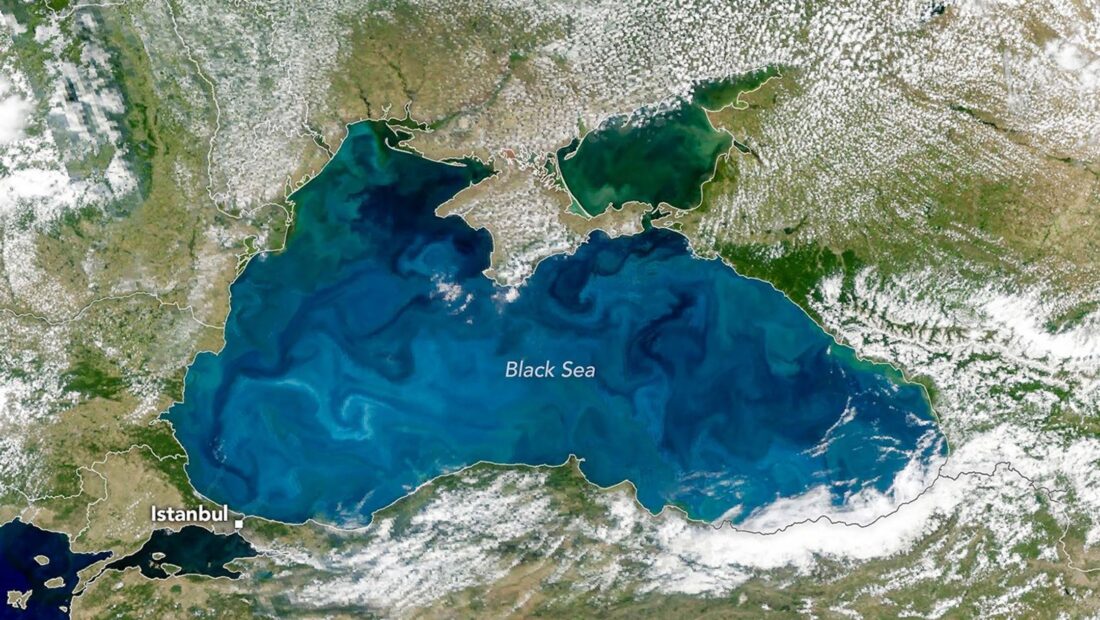
On 27 May 2026, an astronaut aboard the International Space Station photographed the Bosphorus, the narrow strait running through Istanbul that links the Black Sea with the Sea of Marmara. The photograph showed ribbons of turquoise water tracing the currents on both sides of the channel.
From hundreds of kilometres above Earth, the patterns looked almost painted onto the water’s surface. The image gave researchers a close-up view of how a seasonal colour bloom extended into one of the world’s busiest maritime passages.
Roughly a month later, on 22 June 2026, NASA’s PACE satellite captured a wider view of the same phenomenon spreading across the Black Sea itself. The Ocean Color Instrument aboard PACE recorded large areas of milky blue and turquoise water, with the colour extending into nearby waterways.
NASA scientists say the turquoise shade comes from blooms of coccolithophores, tiny phytoplankton covered in calcium-carbonate plates. When these organisms multiply in large numbers, sunlight reflecting off their plates gives the surrounding water a pale, milky appearance that can be seen from orbit.
These blooms tend to peak in late spring and early summer. During other parts of the year, diatoms, phytoplankton with silica-based shells, become more common instead, and their presence tends to darken the water rather than lighten it.
NASA notes that the shifts in colour reflect changes in biological activity in the sea, not any alteration to the water itself. Because the coccolithophore blooms are so reflective, they are also relatively simple for satellites to detect, giving scientists a tool to track marine ecosystem changes over wide stretches of water.
NASA Earth Observatory/by Michala Garrison
Leave a Reply