6,000 Dives Reveal Antarctica’s Hidden Food Puzzle for Penguins
Bio-logging trackers fitted to Adélie penguins in East Antarctica reveal that krill grow harder to reach the longer a colony keeps hunting the same waters.
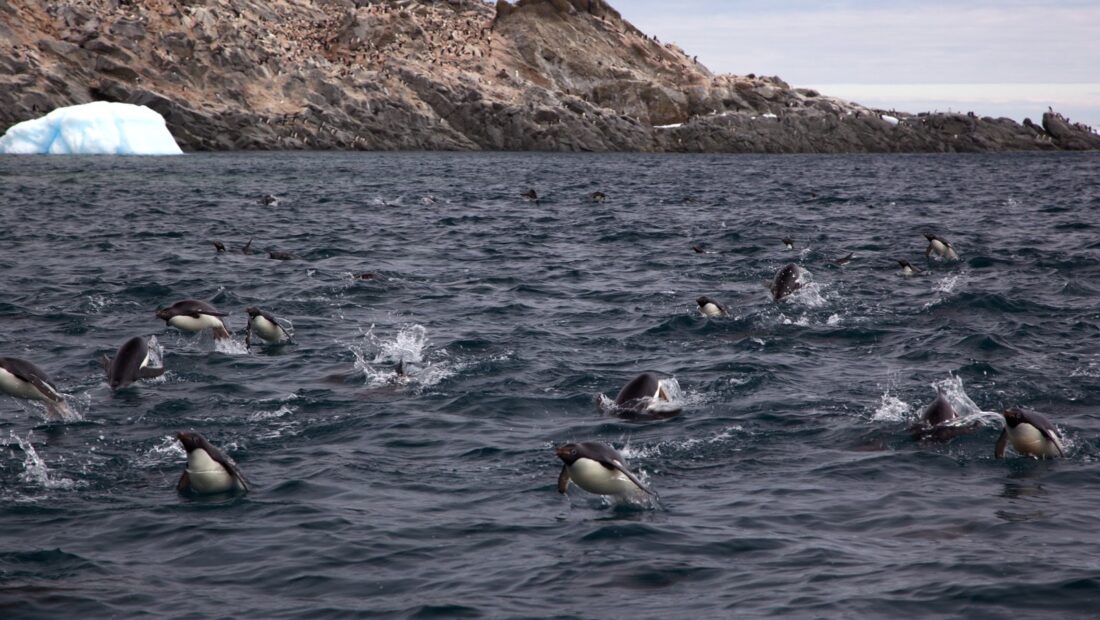
Tracking a wild animal underwater in one of the most hostile environments on Earth is no small feat, but that is exactly what a team of Japanese researchers set out to do off the coast of East Antarctica, fitting breeding Adélie penguins with advanced bio-logging devices to see, for the first time in this kind of detail, how a colony’s hunting reshapes its own food supply.
The devices recorded the birds’ movements, dive depths and feeding events as three-dimensional data, backed up by video footage. Across 30 foraging trips, the team tracked 23 penguins through more than 6,000 dives beneath thick sea ice that covered the bay around their colony, forcing the birds to enter and exit the ocean through only a handful of shared holes in the ice.
The study, led by Hina T. Watanabe, a postdoctoral scholar at Japan’s National Institute of Polar Research, and published on 15 July in the Proceedings of the Royal Society B, set out to test a long-standing idea in seabird biology known as Ashmole’s halo — the pattern in which food appears to grow scarce in the waters immediately around large seabird colonies. Scientists traditionally explained this by assuming thousands of birds simply ate most of the nearby prey, forcing the survivors to travel farther afield.
‘Traditionally, this pattern has been mainly explained by prey depletion: predators consume prey near the colony, reducing prey abundance,’ Watanabe said. ‘However, prey may also become harder to catch if they change their behaviour or distribution in response to predators.’
That is precisely what the tracking data showed. Each time penguins repeatedly used the same entry point into the water, they had to dive deeper and swim farther to find prey — yet once they reached the krill, their feeding rate stayed unchanged, meaning the krill had not actually vanished, only relocated away from the penguins’ usual hunting grounds.
‘We found that penguins had to dive progressively deeper and farther to encounter prey, but once prey were encountered, feeding rates remained unchanged,’ Watanabe said. ‘This suggests that prey accessibility, not only prey abundance, can shape predator foraging patterns.’ Because that diving pressure is concentrated near breeding colonies, she added, local prey displacement can build up over time into what her team calls functional prey depletion — food that is technically present but progressively harder to reach.
Wikimedia Commons/by Jason Auch
Leave a Reply