A woman’s amber hairpin and a man’s chariot: inside Italy’s newest ancient royal burial
Side-by-side graves uncovered in Sirolo, Italy reveal how a Piceni warrior prince and a woman buried near him were laid to rest with chariots, weapons and ornate jewellery 2,500 years ago.
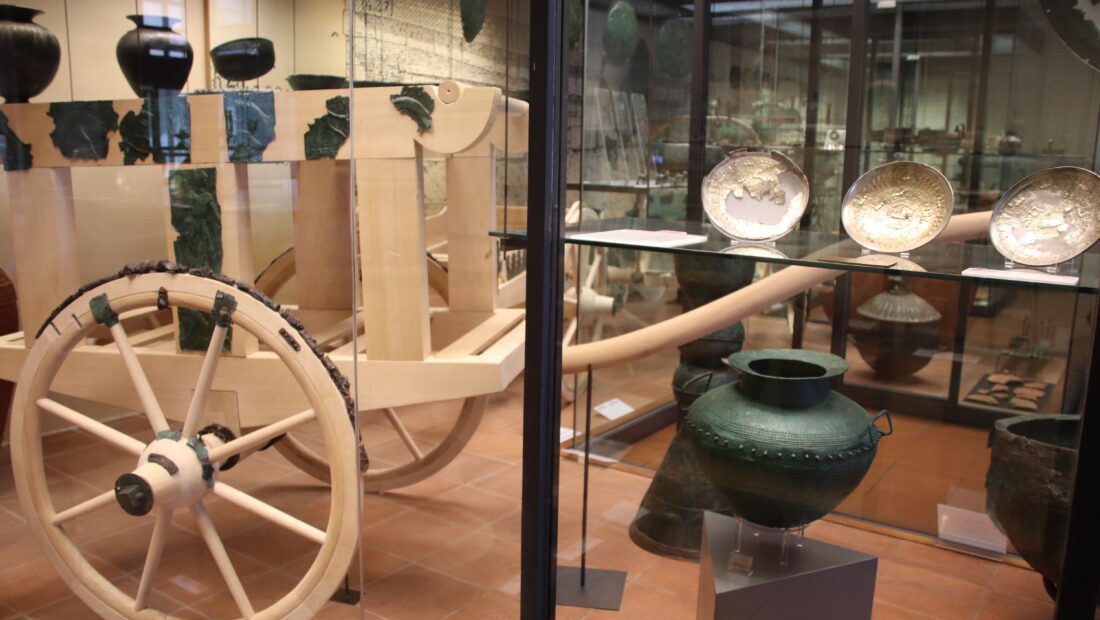
Two graves, laid side by side for 2,500 years, are giving archaeologists an unusually detailed picture of how Italy’s ancient Piceni elite were sent into the afterlife. The burials were uncovered in Sirolo, on Italy’s Adriatic coast, as part of a sixth-century BC complex announced on July 1 by the Superintendency of Archaeology, Fine Arts and Landscape for the Provinces of Ancona, Pesaro and Urbino.
The first grave, set at the centre of a large circular wooden enclosure, belonged to a man buried with an intact wooden two-wheeled chariot called a currus, along with a helmet, an axe and bronze vessels sealed with ceramic lids believed to hold food offerings or remnants of a funeral feast.
Right beside him lay the grave of a woman, buried with textiles, shoes and several fibulae — ornate pins used to fasten clothing in the ancient world. One large fibula, inlaid with amber, was found near her head and may have been part of an elaborate headdress. Her burial sits close to the well-known Queen’s Tomb, discovered in 1989, which contained another Piceni woman buried with two chariots and two mules.
The Piceni, who shared their northern border with the Etruscans, left behind very few written records, meaning burials like these are among the only ways researchers can study their society. This particular cemetery also broke from tradition structurally: rather than the ditch typically used in earlier Piceni burial grounds, it was enclosed by a wooden palisade and built on a small hill, a design experts believe was meant to highlight its significance.
Archaeologists say the discovery marks the first time they’ve identified a complete aristocratic nucleus of the Piceni in one location, building on an earlier 2020 find in the same cemetery that revealed another princely tomb with its own iron-wheeled chariot and weapons.


Leave a Reply